What Landscape Lighting Actually Costs in Knoxville (and Why Most Yards Get It Wrong)
What Landscape Lighting Actually Costs in Knoxville (and Why Most Yards Get It Wrong)
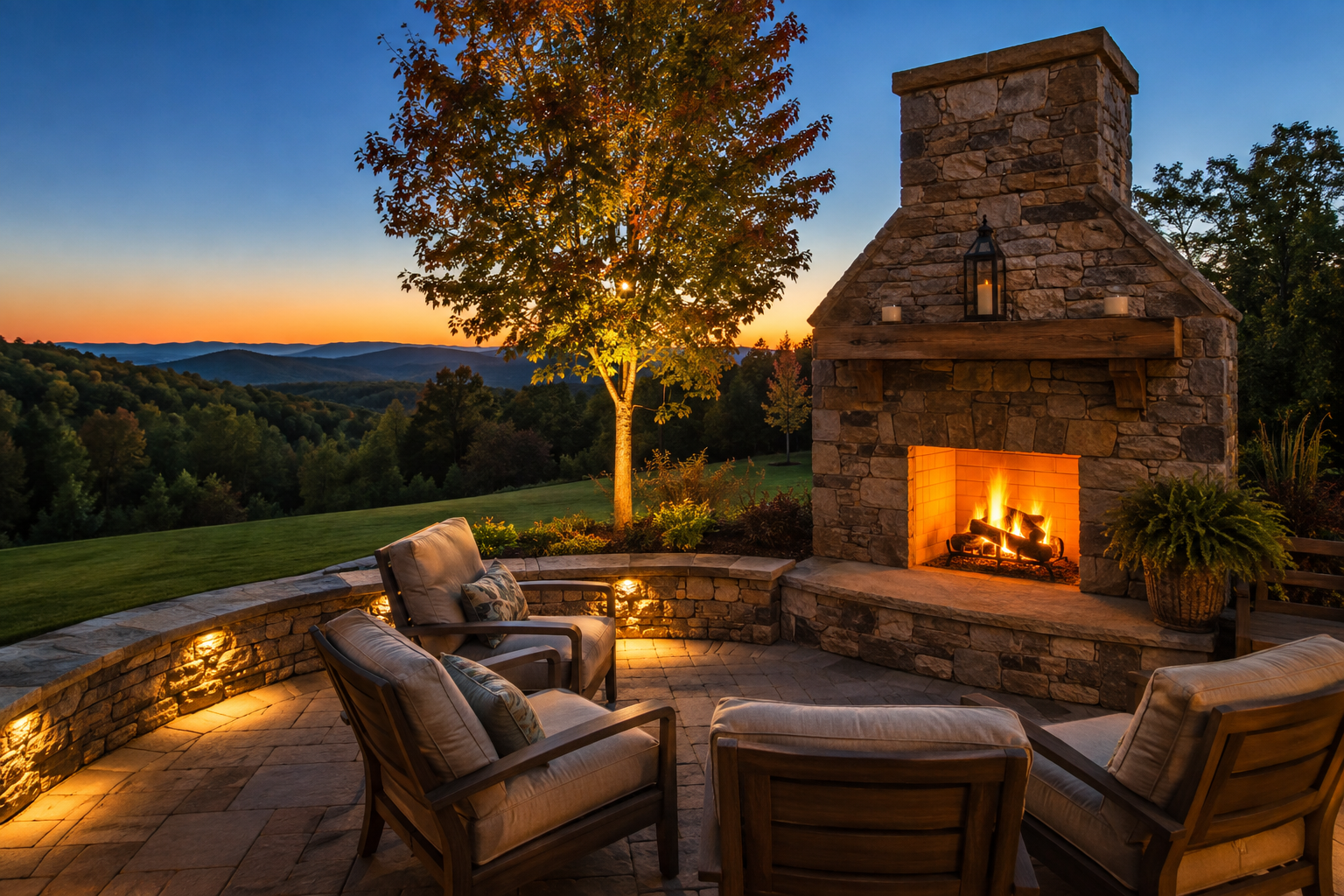
There is a specific week every fall when homeowners notice the problem. The clocks go back on November 1st, and suddenly you get home from work and your backyard is a black hole. That patio you spent thirty grand on last spring is invisible by 5:30. The retaining wall you were so proud of might as well not exist.
By the time we hit the shortest days in December, Knoxville is losing the sun before 5:30 in the evening. That means the backyard you built for entertaining is unusable during the exact hours you are actually home to enjoy it. Lighting is the difference between an outdoor space you use eight months a year and one you use all twelve.
Here is what a real system costs in the Knoxville area, what drives the price, and the design decisions that separate a yard that looks expensive at night from one that looks like a runway.
The Actual Numbers for 2026
Most homeowners have no reference point for lighting, so the quotes feel arbitrary. They are not. The math is fairly simple once you know what drives it.
In the Knoxville market, a professionally installed low voltage LED landscape lighting system typically runs between $2,500 and $8,000, with most residential projects landing somewhere in the middle of that range. The single biggest variable is how many fixtures you need. Budget roughly $200 to $400 per fixture installed, which covers the fixture itself, the wire, the transformer capacity it draws, and the labor to bury the run and aim it properly.
Scale from there. A small accent install, meaning a few uplights across the front of the house, starts around $2,500. A full property with path lighting, tree uplighting, architectural accents, and a couple of control zones lands in the $7,500 to $15,000 range depending on how much of the yard you light and how far the wire has to travel.
That per fixture number is where people get surprised, because they price fixtures online, see fifty dollar path lights at the big box store, and assume the contractor is marking things up six times over. What they are actually paying for is the difference between a fixture that lasts three years and one that lasts twenty.
Why Cheap Fixtures Fail Faster Here Than Almost Anywhere
East Tennessee is genuinely hard on outdoor electrical equipment, and it comes down to two things.
The first is moisture. We are humid most of the year, we get real rainfall in every season, and our soil holds water. Aluminum and plastic fixtures corrode at the socket and the lens gasket, water gets into the housing, and the light either flickers or dies. Cast brass and copper cost more up front and are effectively immune to this. They develop a patina over the years and keep working.
The second is the freeze and thaw cycle. Knoxville does not get a hard sustained freeze like the upper Midwest. What we get is worse for equipment: repeated swings across the freezing line, sometimes several in a single week. Water sitting in a fixture housing or a wire connection expands and contracts over and over. Cheap crimp connectors and gel caps fail from this. Waterproof silicone filled connections do not.
The third factor is our clay soil, which shifts as it takes on and loses water. Wire buried too shallow or run without slack gets pulled tight over a few seasons, and you get an intermittent fault somewhere along a hundred foot run that is miserable to trace. Proper burial depth and slack loops at each fixture cost a little more labor and save you an expensive service call.
The Design Mistakes That Make a Yard Look Cheap
Cost is only half the conversation. We get called out regularly to fix systems that work perfectly and still look bad.
Runway lighting. This is the most common one by a wide margin. Someone lines both sides of a walkway with evenly spaced path lights, all identical, all the same height, and the result looks like an airport. Good path lighting is staggered, not mirrored, and it is spaced wider than you think. You are lighting the surface of the walk, not marking its edges.
Too much light. Homeowners consistently overestimate how much output they need. Your eyes adjust to darkness. A yard lit to daytime levels looks flat and harsh, and it destroys the contrast that makes lighting beautiful in the first place. The goal is pools of light with shadow between them, not uniform coverage.
Wrong color temperature. This one matters more than anything else on the list. Anything above 3000K reads blue and clinical outdoors. It makes brick look gray, makes plants look dead, and makes a warm stone patio feel like a parking garage. We stay at 2700K for almost everything. Some designers go to 2200K for a candle like quality on stone. The important part is consistency: mixing color temperatures across one yard is visually jarring even to people who cannot name what is bothering them.
Glare. If you can see the bulb, the fixture is aimed wrong or it needs a shield. A well designed system means you see lit surfaces, not light sources. This also keeps you out of trouble with neighbors, since Knoxville addresses glare and light spilling onto adjoining properties, and plenty of subdivisions and HOAs in Farragut and West Knoxville have their own rules layered on top. Worth checking before you install anything that points sideways.
Ignoring what the light lands on. Uplighting a tree with a smooth trunk produces a plain stripe. Uplighting a tree with deep bark texture produces something dramatic. Grazing a stacked stone wall from a foot away makes every stone read individually. The same fixture in two places gives completely different results, which is why aiming at night matters more than the plan drawn in daylight.
What Actually Belongs in a Knoxville Backyard
A good system layers a few different techniques instead of repeating one.
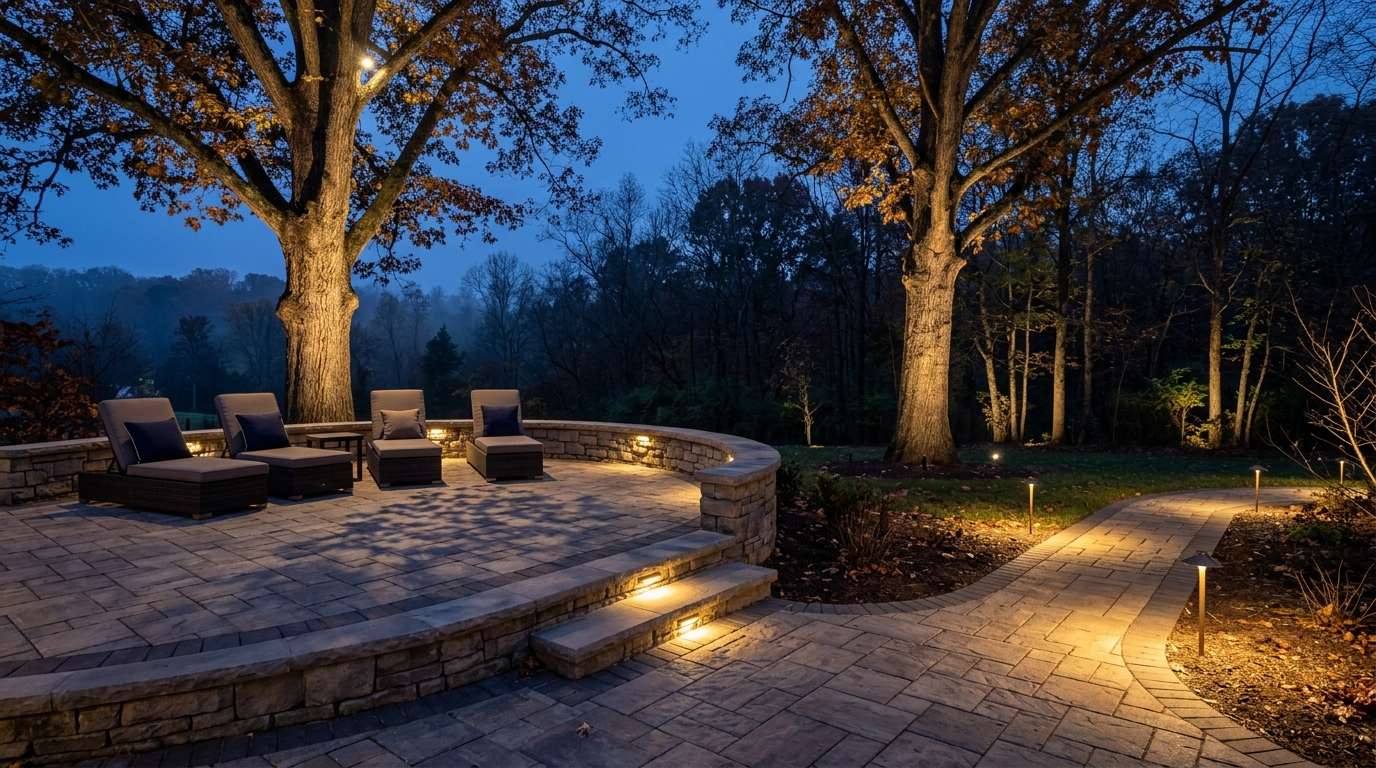
Uplighting on mature trees. East Tennessee properties tend to have real trees, and this is where you get the most visual payoff per dollar. Two fixtures at the base of a large oak, aimed up through the canopy, do more for a backyard at night than a dozen path lights. On wooded lots backing to a tree line, lighting the first row of trunks creates depth and makes the yard feel like it has walls.
Downlighting from above. Fixtures mounted high in a tree, aimed down, mimic moonlight and cast leaf shadows across a patio. This is the single most underused technique in residential lighting and it is gorgeous over a seating area or a pool deck.
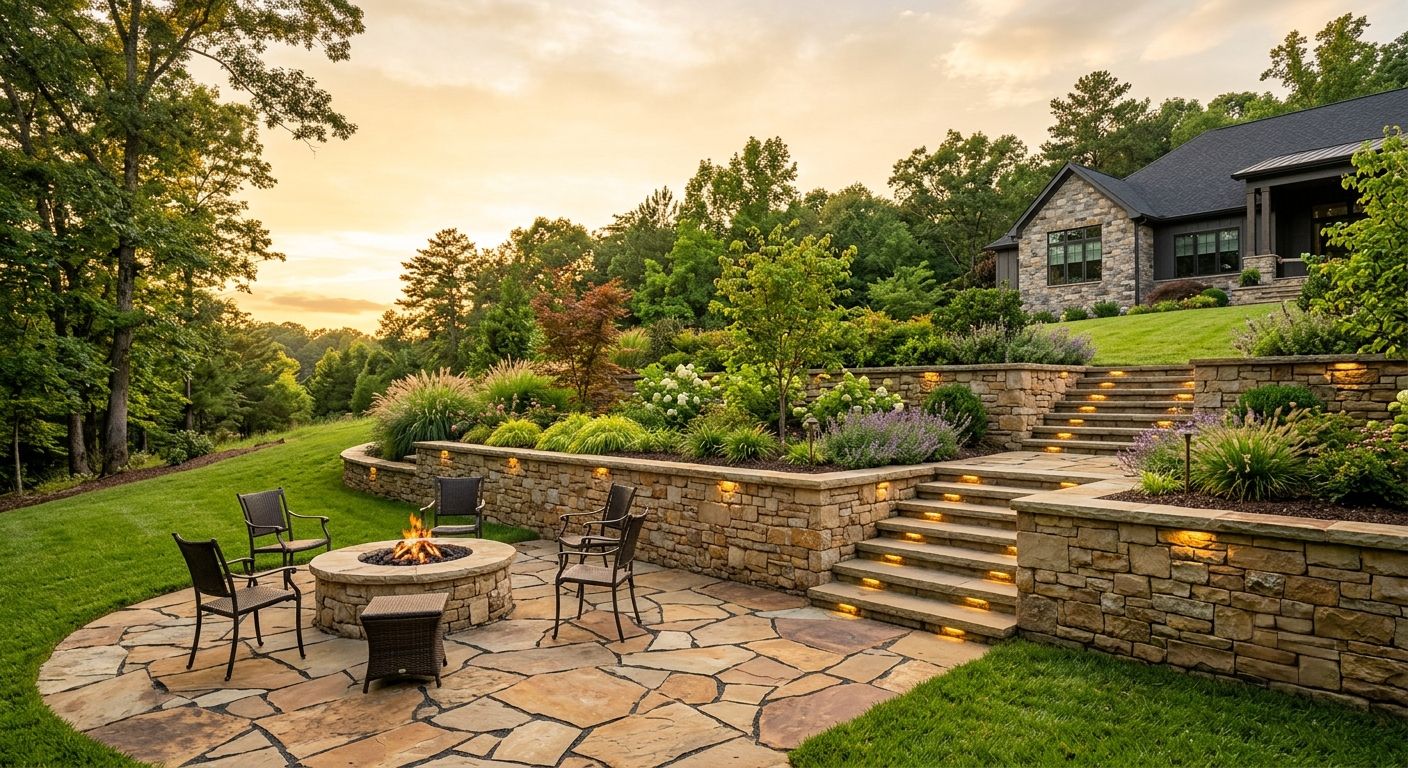
Hardscape and step lighting. Any change in elevation should be lit, and on Knoxville's sloped lots there are usually several. Lights integrated into seat walls, under cap stones, or recessed into steps handle safety without adding visible fixtures. This is also the detail that makes a retaining wall look intentional at night instead of disappearing.
Architectural washes. Uplighting the front of the house at the corners and between windows adds curb appeal and does real work for security. Shadowed entry points are where problems happen.
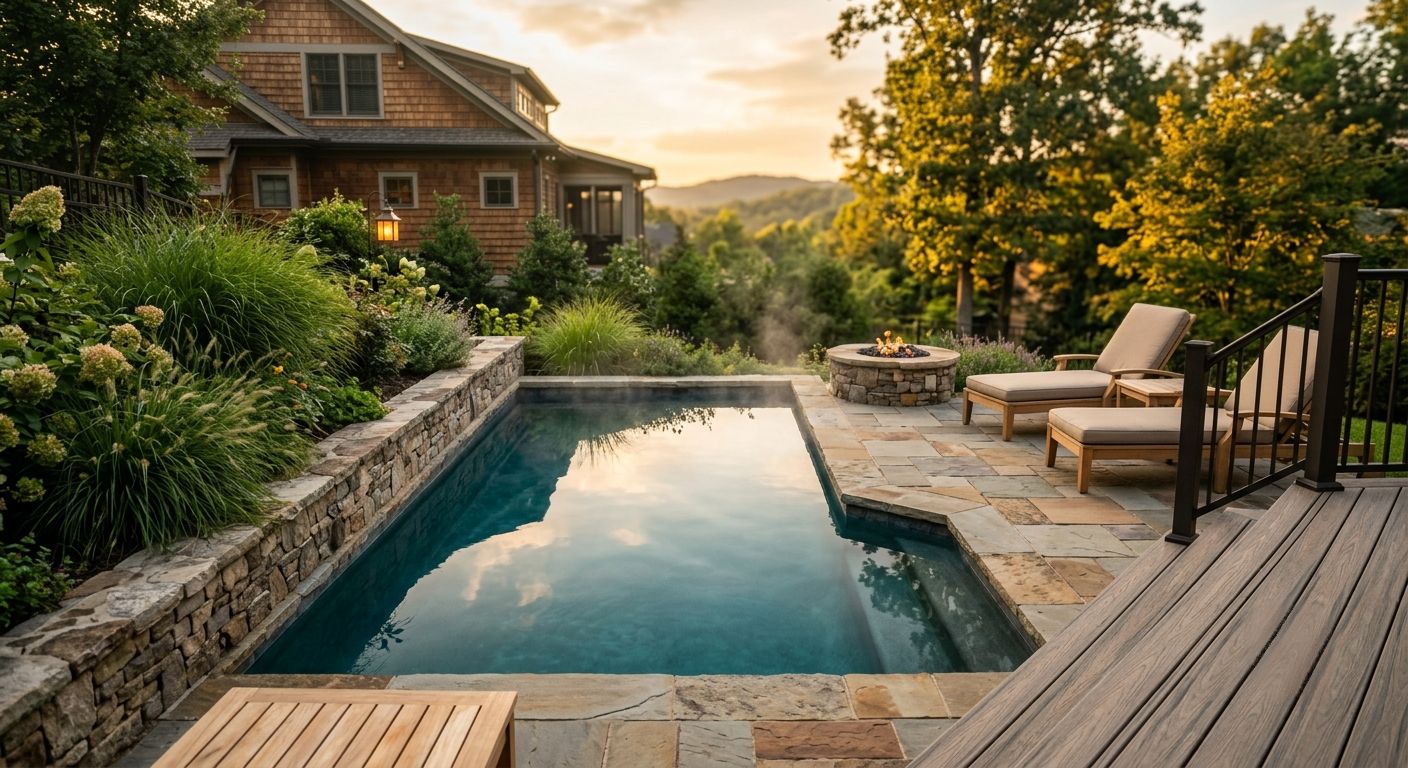
Water and fire accents. If you have a pool, lighting inside and around it changes the whole character of the yard after dark. Same with a fire feature. These elements are already focal points, and lighting them is what keeps them focal after sunset.
Retrofit or Build It In?
If you already have a finished patio, adding lighting later is absolutely doable. It costs more in labor because we are boring under existing hardscape or working around irrigation and root systems, but it is routine work.
The cheaper path is running conduit and sleeves during hardscape construction. If a patio, walkway, or retaining wall is being built, adding a few sleeves under it costs very little at that moment and saves a lot later. This is one of the real advantages of working with a design build team that handles grading, hardscape, and lighting as one scope rather than three separate contractors who never talk to each other. The patio crew knows where the lighting runs are going because it is the same company.
Even if lighting is not in this year's budget, ask whoever is building your hardscape to sleeve it. It is an inexpensive decision that keeps your options open.
One Thing Worth Knowing About Timing
Fall and winter are the best time of year to install landscape lighting, and not for the obvious reason.
Yes, you get the benefit immediately during the darkest months. But the practical advantage is that aiming is a nighttime job, and in late December we can start aiming a system at 5:30 in the evening instead of waiting until 9:00 in July. Crews get more done, systems get dialed in more carefully, and scheduling is easier because most landscape companies see demand drop off after the fall rush.
If you have been thinking about it, the window between now and spring is the right one.
Let Us Walk the Property
Landscape lighting is one of the few upgrades where the design matters more than the budget. A thoughtfully placed $4,000 system beats a poorly planned $12,000 one every single time, and we would rather build you the first one.
Dodson Designs handles landscape lighting as part of full outdoor living design and build across Knoxville, Farragut, Maryville, and the surrounding area, which means the lighting plan accounts for the hardscape, the grading, and the planting because we are handling all of it. Reach out for a consultation and we will walk your property, talk through what is worth lighting, and give you a real number.