What a Paver Patio Actually Costs in Knoxville (2026), and Why Three Quotes Can Differ by $20,000
What a Paver Patio Actually Costs in Knoxville (2026), and Why Three Quotes Can Differ by $20,000
Here is a conversation we have a few times a month. A homeowner in Farragut gets three bids on the same patio. One comes in at $9,000. One comes in at $19,000. One comes in at $31,000. Same square footage, same general idea, same yard. They call us confused and a little suspicious, because somebody in that group has to be ripping them off.
Usually nobody is. The three contractors priced three completely different projects, and the homeowner could not see the difference because most of what separates them is buried under the pavers where nobody will ever look at it.
That buried part is the whole ballgame in East Tennessee. Our soil, our slopes, and our freeze and thaw pattern are unusually hard on hardscape, and the base underneath a patio decides whether you have a beautiful surface in fifteen years or a wavy, sunken mess in four. So let us go through what the real numbers look like in Knoxville right now, what drives them, and how to read a quote well enough to tell a bargain from a future problem.
The Honest Range for 2026
Published pricing for Knoxville paver patios is all over the map, and I want to show you that spread rather than pretend there is one clean number.
Local 2026 guides put a professionally installed paver patio in the Knoxville area at roughly $15 to $35 per square foot, with a typical 300 square foot patio, enough for a dining table and a seating area, landing between $4,500 and $10,500 installed. A 400 square foot patio, which is the common 20 by 20, generally runs $6,000 to $14,000 installed depending on paver choice, site access, and features like seating walls or lighting.
At the higher end of the market, the numbers climb sharply. Some Knoxville design build firms report installed paver pricing running roughly $38 to $65 per square foot, with project minimums in the $35,000 range. Another local hardscape company prices patio projects between $30 and $50 per square foot, with a 500 square foot patio landing in the $20,000 to $30,000 range and a 1,200 square foot high end space running $60,000 and up.
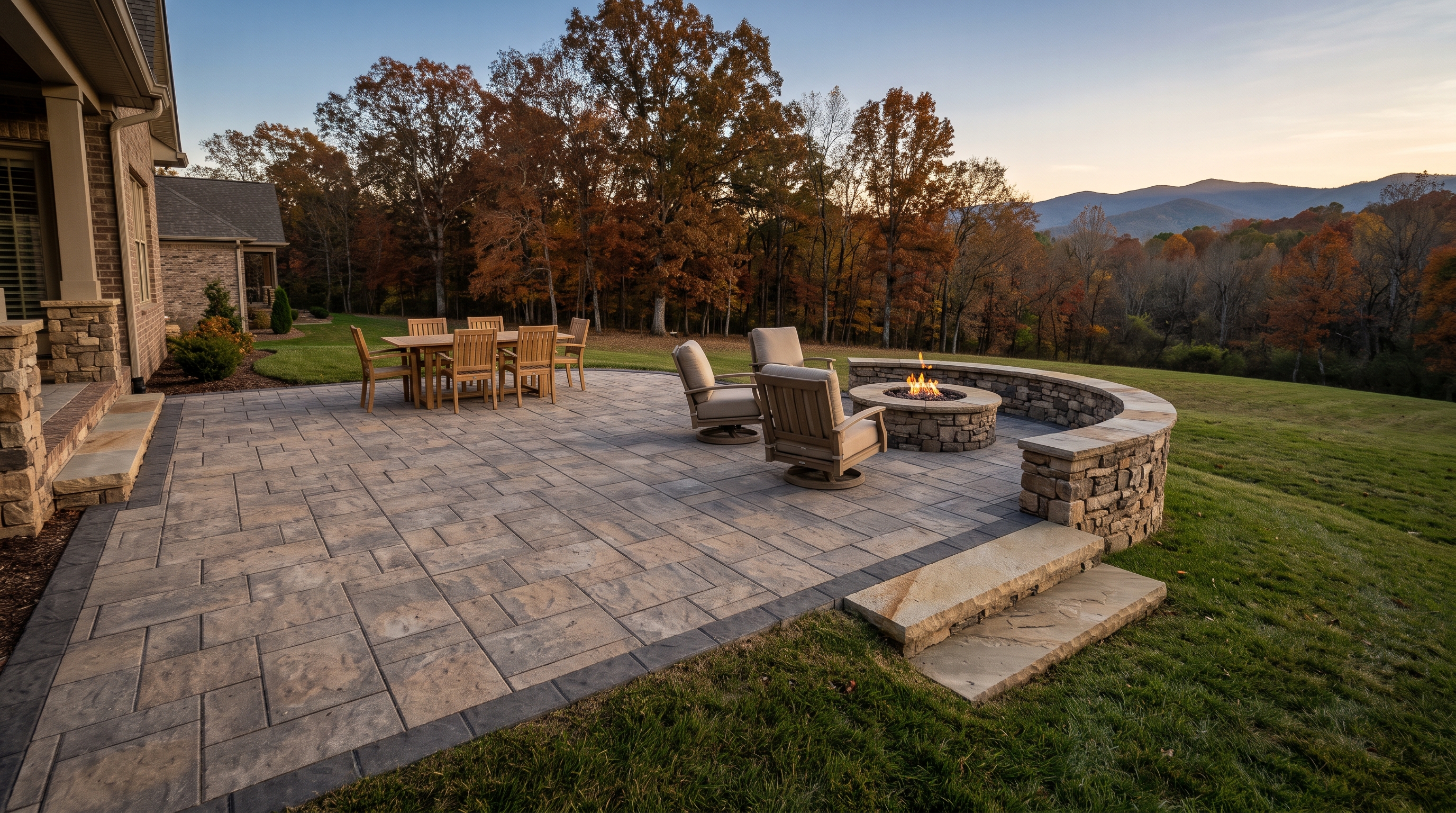
Those are not contradictory. They describe different tiers of work. The low end of that spread is a modest concrete paver on a standard base with simple edges. The high end is travertine or porcelain, a reinforced base, custom cuts and borders, seat walls, integrated lighting, and drainage work on a difficult lot. Both are real patios. They are just not the same product, and the quote rarely explains which one you are buying.
Material choice alone accounts for a big chunk of it. Concrete pavers tend to land around $8 to $15 per square foot for the material, porcelain pavers around $12 to $18, and natural stone including Tennessee fieldstone and regional quarry stone around $15 to $25. Natural stone patios installed typically run $25 to $40 per square foot and up.
The Base Is Where Your Money Actually Goes
If you take one thing from this article, take this: you are not buying pavers. You are buying the twelve inches underneath them.
A paver patio is a flexible pavement system. The pavers are just the wear surface. Underneath is compacted aggregate base, then a thin bedding layer, and the whole thing moves slightly as a unit with the ground. Build that base correctly and it distributes load and drains water. Build it wrong and the patio telegraphs every problem in the soil below.
East Tennessee makes this harder than most places for three specific reasons.
Our clay is expansive. Knoxville area soils hold water and swell, then shrink as they dry out. That cycle runs all year and it is relentless. A patio sitting on undersized base over raw clay gets pushed up and dropped repeatedly until the joints open and the surface goes wavy. Real base depth and a separation layer between the clay and the aggregate are not upgrades. They are the job.
Our freeze and thaw pattern is the bad kind. We do not get a single deep winter freeze the way the upper Midwest does. We get repeated crossings of the freezing line, often several in one week, usually with wet ground. Water in a poorly draining base freezes, expands, thaws, and does it again. That is what heaves pavers. A clean, open graded or properly compacted dense graded base with somewhere for water to go handles it. A thin layer of sand over dirt does not survive it.
Our lots slope. Most backyards we work in around West Knoxville, Hardin Valley, and Maryville fall away from the house, and a lot of the level looking areas are fill dirt pushed there when the subdivision was graded. Fill has not finished settling and will keep moving for years. Building a patio on unverified fill without proper compaction is how you get a corner that drops two inches in the first eighteen months.
This is why enhanced base preparation for clay conditions commonly adds $800 to $2,000 to a project, and why grading and site preparation in Knoxville typically runs $3 to $5 per square foot for basic work and $5 to $8 or more per square foot when extensive grading with drainage solutions is required. On a sloped lot those line items are not padding. They are the reason the patio lasts.
When you compare bids, the cheap one has almost always cut here. It is the easiest place to cut because the customer cannot see it, and it is the most expensive place to be wrong.
The Site Costs Nobody Puts in the Brochure
Beyond the base, a handful of site conditions move the number meaningfully.
Demolition. If there is an existing concrete slab or old patio in the way, it has to come out. Removal typically runs $2 to $3 per square foot for concrete and $3 to $5 per square foot for stone or pavers. Hauling it off is not free either.
Access. This one surprises people more than anything else. If a skid steer can get to the backyard through a gate or around the side of the house, excavation and material delivery are efficient. If the only route is through a narrow side yard, down a steep grade, or between the house and a fence, the crew is moving many tons of aggregate by wheelbarrow. On a tight lot that can add days of labor. Two identical patios on two different lots can differ by thousands for this reason alone.
Elevation changes. A patio that needs to step down to meet grade requires steps, and steps require footings or a reinforced base of their own. Seat walls and raised patios mean structural work, not just surface work.
Drainage. Any patio changes where water goes. You are converting a surface that absorbed rain into one that sheds it. On a sloped Knoxville lot, that water has to be managed deliberately or it ends up somewhere you do not want it, usually against a foundation or in a neighbor's yard.
The Permit Question, and a Trap Inside It
Most homeowners assume a patio needs a permit and are relieved to learn it usually does not. Then they miss the part that actually matters.
For a ground level, uncovered patio, most Tennessee cities including Knoxville do not require a building permit, while adding a patio cover, screened porch, or any roofed structure does require one, with Knoxville permit fees typically running $50 to $200 for residential patio cover projects and review times averaging one to two weeks. Decks, covered patios, porches, and permanent structures are where permits become mandatory.
Here is the trap. A new patio changes how water flows across your property, and Tennessee law holds property owners responsible for not diverting stormwater onto neighboring land. If your project involves regrading, cutting into a slope, or redirecting water flow, you may need a grading permit or stormwater review even when the patio itself is permit exempt.
That applies to a lot of Knoxville backyards, because cutting into a slope is how you get a level patio on a sloped lot. The patio is exempt. The grading that made it possible might not be.
Knox County also has thresholds tied to how much you disturb and how much hard surface you add. The county's land development review process flags residential sites with five feet or more of cut or fill, or 10,000 square feet or more of proposed impervious surface, and the review asks specifically about sinkholes on the site, which are a genuine consideration in parts of Knox County given our karst geology.
On top of that, many Knoxville residential zones cap total impervious surface on a lot, counting roofs, driveways, patios, and similar hard surfaces, and a large patio or driveway extension can push a property over that limit.
None of this should scare you off a patio. The vast majority of residential patios clear all of it easily. But it is worth confirming for your specific address before the first shovel goes in the ground, and it is a reasonable thing to ask a contractor how they handle. If the answer is a blank stare, that tells you something.
How to Read Three Quotes Without a Construction Background
You do not need to know compaction specs. You need to know which questions expose the differences.
Ask for base depth and material in writing. Not "proper base." A number in inches, the type of aggregate, and whether geotextile fabric is going between the subgrade and the base. If one bid says six inches and another says ten over fabric, you have found a large part of your price difference.
Ask how they compact. Compaction should happen in lifts, meaning layers, not all at once at the end. A plate compactor run over twelve inches of loose stone does essentially nothing to the bottom half.
Ask about edge restraint. The perimeter is where paver patios fail first. Pavers need a restraint system spiked into the compacted base to keep the field from spreading over time. Hand packed mortar along the edge is not a substitute and it will crack.
Ask what joint material they use. Polymeric sand locks joints, resists washout in our rain, and slows weeds considerably compared to plain sand. It costs more and it matters here.
Ask where the water goes. The answer should be specific. A slope direction, a drain location, a discharge point. "It'll drain fine" is not an answer on a clay lot.
Ask what happens if it settles. A real hardscape warranty covers settlement and the labor to lift and reset pavers. Pavers themselves usually carry a manufacturer warranty that is close to meaningless, because the pavers are rarely what fails.
Six questions. The answers will sort three quotes faster than any amount of staring at the totals.
Why November Is a Smart Time to Start
Most people call about patios in April, which means April is when everyone is booked and material pricing is at its least flexible.
Winter is better, for a few practical reasons. Hardscape construction does not require warm weather the way concrete pouring and planting do, so crews stay productive through most of a Knoxville winter. Schedules are more open between now and early spring, which means you are not waiting eight weeks for a start date. And the biggest advantage is that designing in winter means building before the spring rush rather than getting in line behind it. A patio finished in March is a patio you use all season. A patio you start planning in April gets finished in July.
The ground conditions are also informative right now. Winter is our wet season, and walking a property in November and December shows you exactly where water collects and where it runs. That is genuinely useful design information you cannot get in a dry August walkthrough.
Build It Once
A paver patio is one of the few outdoor investments that is either done right or done twice. The surface is the part you pick out and fall in love with. The base, the drainage, and the grading are the parts that decide whether you are still happy with it in a decade.
Dodson Designs handles design, grading, drainage, and hardscape as one scope across Knoxville, Farragut, Maryville, and the surrounding area. That matters on a patio more than on almost anything else we build, because the crew setting the pavers is the same operation that evaluated the slope, planned where the water goes, and built the base holding it all up. There is nobody to point at when something moves, which is exactly the accountability you want.
If you are weighing quotes right now, or you want a real number for your yard instead of a range from an article, reach out for a consultation. We will walk the property, look at the grade and the access, and tell you honestly what the site needs before we talk about what the patio costs.